 TM
TM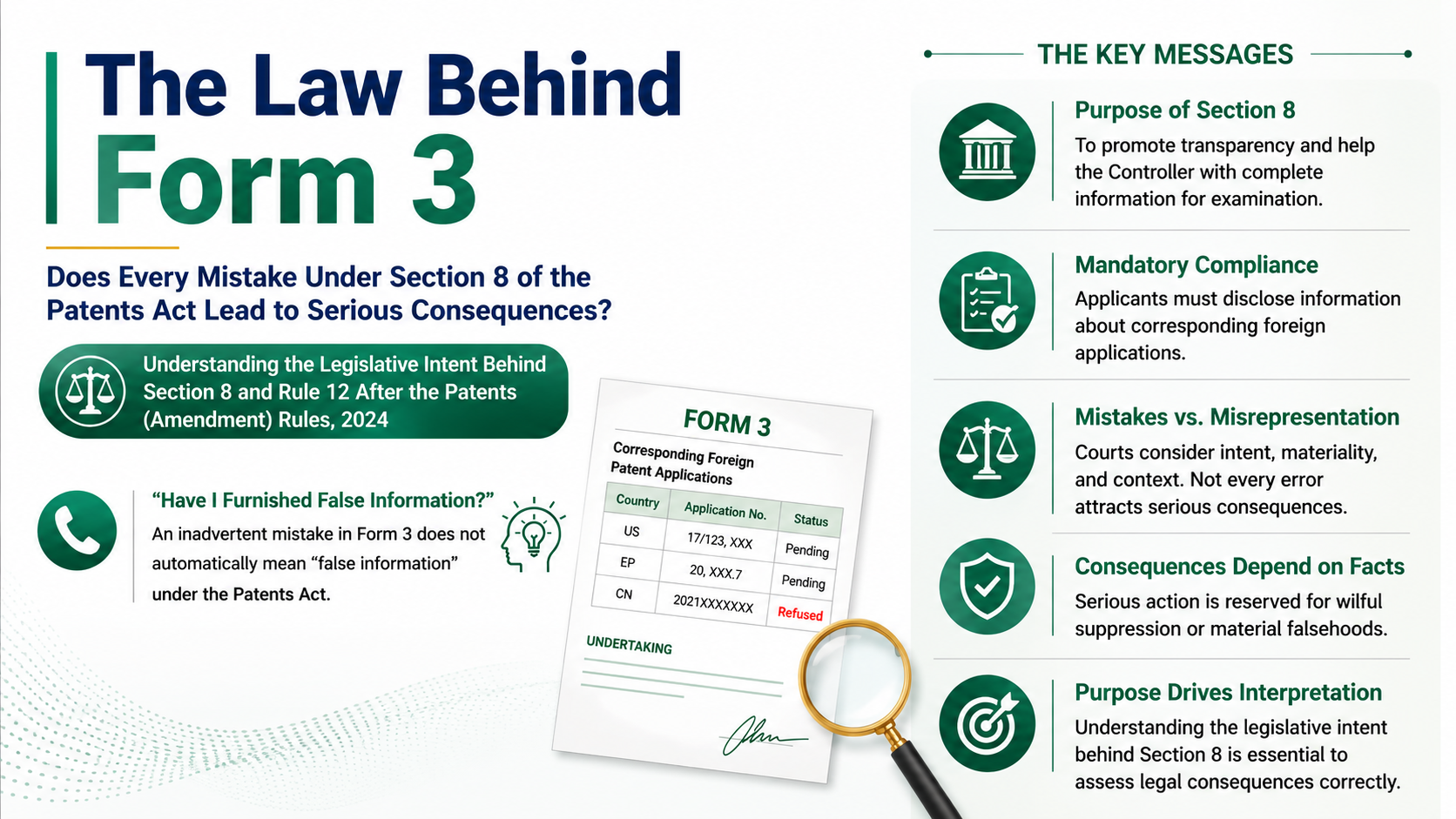
Understanding the Legislative Intent Behind Section 8 and Rule 12 After the Patents (Amendment) Rules, 2024.
"Have I Furnished False Information?"
That was the question my client asked after discovering that one of the corresponding foreign patent applications disclosed in the updated Form 3 had inadvertently been shown as "Pending", whereas the application had already been refused.
The mistake was genuine.
The foreign prosecution records had not yet been updated in the applicant's internal database, and the outdated status was carried into the Form 3 filed before the Indian Patent Office.
The client was understandably anxious.
"Does this mean we have furnished false information under the Patents Act?"
At first glance, the answer may appear straightforward. If the information disclosed is incorrect, it may seem natural to conclude that the applicant has furnished false information.
Patent law, however, rarely operates through such mechanical reasoning.
Whether an incorrect disclosure attracts serious legal consequences depends upon the statutory framework, the purpose underlying the disclosure obligation, and the facts and circumstances surrounding the alleged non-compliance. The law does not assess every mistake in isolation; rather, it evaluates the nature of the error, its materiality, the applicant's conduct, and the overall context in which the disclosure was made.
Understanding these distinctions requires us to step back from the facts of a particular case and examine why Section 8 exists in the first place. Only then can we properly appreciate why some errors may justify serious consequences while others may not.
The Philosophy Behind Section 8
Every statutory provision has a legislative purpose. Section 8 of the Patents Act, 1970, is no exception.
Modern inventions are rarely protected in a single jurisdiction. Businesses, universities, research institutions, and individual inventors routinely seek patent protection in multiple countries through national filings or international patent systems. Consequently, several patent offices may examine substantially the same invention, each applying its own patent laws, examination standards, and procedural requirements.
During these examinations, patent offices may cite different prior art, raise different objections, require claim amendments, or ultimately grant or refuse patent protection. Although each patent office independently determines patentability under its domestic law, developments in one jurisdiction may nevertheless provide valuable information for examination elsewhere.
Recognising this practical reality, Parliament enacted Section 8 to require applicants to furnish information relating to corresponding foreign patent applications.
The purpose of this disclosure requirement is straightforward. It enables the Controller of Patents to obtain relevant information concerning corresponding foreign applications so that the Indian examination process may be conducted with the benefit of a more complete factual record.
Viewed in this context, Section 8 serves an important public interest. It promotes transparency between applicants and the Indian Patent Office, facilitates informed examination, and encourages applicants to cooperate with the statutory examination process by making relevant information available in a timely manner.
Although the Patents Act does not expressly describe Section 8 as imposing a "duty of candour," the disclosure obligation embodied in the provision reflects this broader legislative objective of openness and cooperation during patent prosecution.
Understanding this legislative purpose is essential. Without appreciating why Section 8 exists, it becomes difficult to interpret the legal consequences of alleged non-compliance.
Transparency, Not Technicality
One of the most common misconceptions surrounding Section 8 is that it exists to create procedural traps capable of invalidating patents whenever an applicant commits a technical mistake. That is an oversimplification.
Section 8 undoubtedly imposes a mandatory statutory obligation upon patent applicants to furnish the information required by law. Compliance is therefore not optional. Applicants cannot disregard these disclosure requirements merely because corresponding foreign applications appear irrelevant or because similar information may already be publicly available.
However, acknowledging that the obligation is mandatory does not necessarily answer a different question:
What legal consequences should follow when an applicant commits an error while attempting to comply?
That question requires careful legal analysis.
Section 64(1)(m) of the Patents Act identifies failure to comply with Section 8, or furnishing false information in material particulars, as one of the statutory grounds upon which a patent may be revoked. Importantly, the provision employs the word "may", indicating that revocation is a discretionary remedy rather than an automatic consequence of every instance of non-compliance.
Equally significant is the fact that Section 64(1)(m) identifies two distinct categories of conduct:
- failure to disclose information required under Section 8; and
- furnishing information that is false in material particulars.
Although both situations may raise questions regarding compliance, they are not necessarily identical in either their factual basis or their legal consequences.
This distinction becomes particularly important when examining the wide variety of errors that may arise during patent prosecution. An inadvertent typographical mistake, an administrative delay in updating prosecution records, reliance upon outdated information received from foreign counsel, and deliberate concealment of a corresponding foreign application are fundamentally different situations.
Treating all such circumstances identically would ignore both the factual complexity of patent prosecution and the contextual analysis that courts ordinarily undertake when applying statutory provisions.
Accordingly, Section 8 should not be viewed merely as a technical procedural requirement. Rather, it should be understood as a statutory mechanism designed to facilitate transparent communication between applicants and the Patent Office while ensuring that the examination process proceeds on the basis of accurate and complete information.
This perspective also explains why courts have consistently examined the surrounding facts and circumstances in disputes concerning Section 8 compliance instead of adopting an inflexible or mechanical approach to every alleged error.
Disclaimer: This publication is provided for informational and educational purposes only. While every effort has been made to ensure the accuracy of the information at the time of publication, the law is subject to change and its application depends on the specific facts of each case. This article does not create an attorney-client relationship and should not be treated as legal advice.
#Patents #PatentLaw #IndianPatents #PatentProsecution #Section8 #Form3 #IntellectualProperty #IPLaw #Innovation #PatentPractice #PatentCompliance #LegalUpdates #PatentAgents #PatentAttorneys #InnovationManagement #IPStrategy #CorporateIP #InKnowBizAssociates #KnowledgeCentre #PatentLitigation