 TM
TM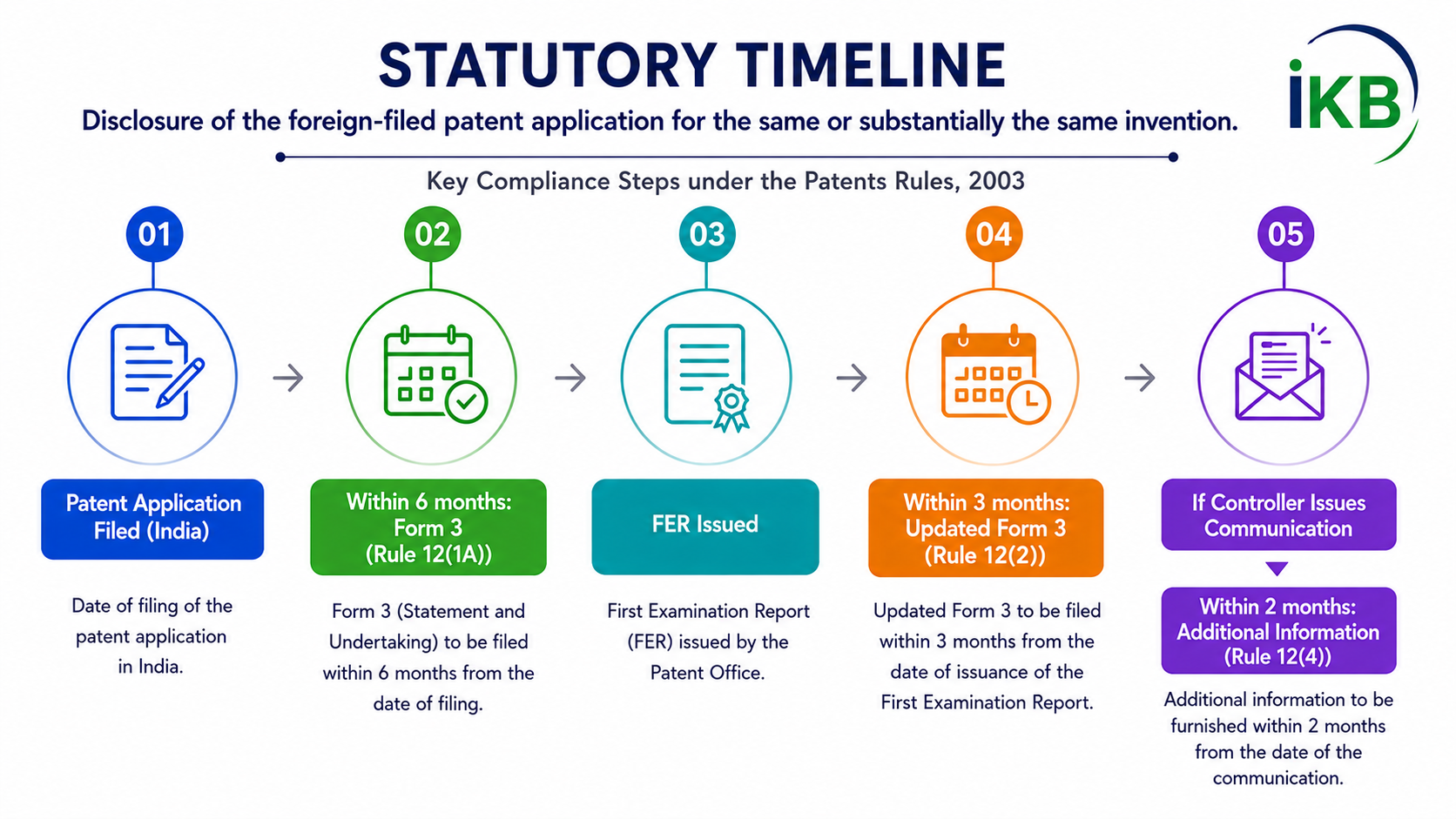
While Form 3 is relatively short, it is a statutory declaration provided to the Indian Patent Office in accordance with Section 8 of the Patents Act, 1970 and Rule 12 of the Patents Rules, 2003.
The information given is part of the official prosecution file and must thus be prepared with the same care as the patent specification itself. The message to all applicants is clear:
Give Form 3 the same attention to detail and the same checking and rechecking as the patent specification.
A few minutes spent on checking the status of matching overseas applications before filing Form 3 may save unwanted explanations, procedural complexities or disagreements at a later stage.
Form 3: Procedural form or statutory declaration?
One of the most important modifications that has been brought in is the relaxation of the disclosure requirements under Section 8 of the Patents Act, 1970 read with Rule 12 of the Patents Rules, 2003, by the Patents (Amendment) Rules, 2024, having effect from 15 March 2024.
Most applicants think the Form 3 is filed only once. The amended Rule 12, in practice, provides for three different places where an applicant may be required to provide information.
1. Initial Form 3, Regulation 12(1A)
All applicants are required to file the Statement and Undertaking in Form 3, within six months from the date of filing the patent application in India.
The first filing is to notify the Indian Patent Office regarding the comparable foreign patent applications for the same or essentially the same innovation.
2. Form 3 as amended Rule 12(2)
The 2024 amendments have also made compliance easy by requesting applicants to submit an updated Form 3 within three months from the date of issuance of the First Examination Report (FER).
This revision significantly decreases the compliance burden compared to the previous regime under which applicants had to keep the Controller informed of the status of matching overseas applications throughout prosecution.
The goal of the legislation is obvious; it is to ease compliance with the procedures while maintaining transparency in front of the Patent Office.
3. Further on the Controller's power to direct Rule 12(4)
The revised Form 3 does not necessarily relieve the applicant of his responsibility.
The Controller may at any point during the prosecution of the application request the applicant to supply such supplementary information pertaining to equivalent foreign applications as he considers essential for the examination.
If such a notification is issued, the applicant shall submit the information requested within two months from the date of the communication of the Controller.
Therefore, even though the regular obligation to give periodic updates has been abolished, the Controller still possesses the statutory power to ask for more information whenever the facts and circumstances of a specific instance justify it.
Conclusion
Form 3 is far more than a procedural form, it is a statutory declaration that should be prepared with the same care as the patent specification.
The amended Rule 12 has simplified compliance, but not the obligation to provide accurate and timely disclosures.
Practical takeaway: Before filing every Form 3, whether under Rule 12(1A), Rule 12(2), or in response to the Controller under Rule 12(4), verify the latest status of all corresponding foreign applications. A few minutes of verification today can prevent avoidable objections, delays, and complications during patent prosecution tomorrow.
#PatentLaw #IndianPatentLaw #Section8 #Form3 #PatentCompliance #PatentProsecution #PatentsAct1970 #IntellectualProperty #IPLaw #PatentPractice #PatentAgents #LegalInsights
Disclaimer: This article is intended for educational and informational purposes only and does not constitute legal advice or a legal opinion. It is based on the author's practical experience and professional understanding of Indian patent law. Readers should seek independent professional advice before acting on any information discussed herein.