 TM
TM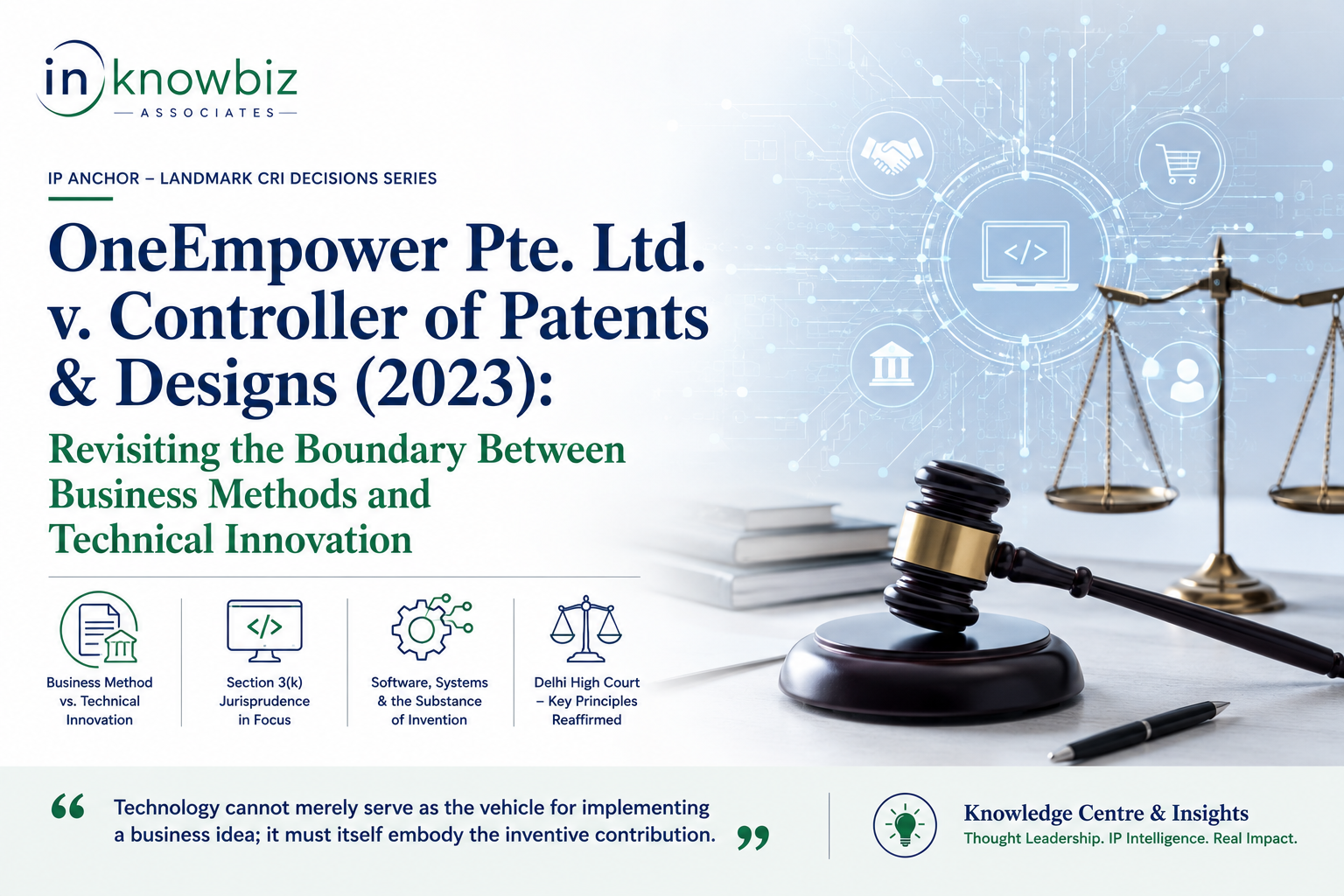
Citation
OneEmpower Pte. Ltd. v. Controller of Patents & Designs, 2023:DHC:4077, C.A.(COMM.IPD-PAT) 8/2023, decided on 8 May 2023 (Delhi High Court).
Introduction
The jurisprudence relating to Computer Related Inventions (CRIs) in India has evolved significantly over the past decade. Following Ferid Allani v. Union of India, Indian courts have consistently emphasized that patent eligibility cannot be determined merely by identifying the presence of software within an invention. Instead, the enquiry must focus on whether the invention, viewed as a whole, provides a technical solution to a technical problem. Against this backdrop, the Delhi High Court's decision in OneEmpower Pte. Ltd. v. Controller of Patents & Designs occupies an important place in the continuing development of Section 3(k) jurisprudence.
Although the appeal ultimately did not result in the grant of a patent, the judgment provides valuable guidance on distinguishing genuine technical innovations from inventions whose essential contribution lies in a business method implemented through computer technology. It also reiterates that patentability under Section 3(k) must be determined by examining the substance of the invention rather than the terminology employed in the claims.
Background and Facts
The appellant, OneEmpower Pte. Ltd., is a technology company engaged in loyalty marketing and commerce solutions. It sought patent protection in India for an invention titled "A Transaction Reward System". The invention was designed to enable consumers to redeem reward points directly through a financial institution without requiring any modification to the retailer's payment terminal. By allowing reward redemption to occur independently of the retailer's processing system, the invention claimed to simplify reward redemption while reducing operational complexity and associated costs.
The Patent Office, however, rejected the application under Section 15 of the Patents Act on the ground that the claimed invention was directed to both a business method and a computer programme per se, rendering it non-patentable under Section 3(k). Challenging this decision, the appellant argued that the invention addressed a technical problem by improving the architecture of reward redemption and producing a demonstrable technical effect.
The Central Issue Before the Court
The principal question before the Delhi High Court was whether the claimed invention merely automated a commercial reward redemption process or whether it constituted a patentable technical invention by solving a technical problem through technical means.
More specifically, the Court was required to determine whether the invention's true contribution lay in an improvement to computer technology itself or merely in facilitating a commercial transaction using conventional computing infrastructure.
The Court's Analysis
Justice Sanjeev Narula approached the dispute by emphasizing that Section 3(k) requires courts to identify the real substance of the invention. Merely incorporating computers, communication devices, software modules or network components into a claim cannot convert an otherwise excluded subject matter into patentable subject matter.
The Court observed that the claimed invention certainly utilised technological components such as mobile communication devices, financial institution servers and transaction interfaces. Nevertheless, the decisive enquiry was not whether computers were involved, but whether these components collectively solved a technical problem in the functioning of the computer system itself.
On examining the complete specification, the Court concluded that the invention primarily reorganised the manner in which reward points were redeemed during commercial transactions. The technical components performed their ordinary and expected functions without introducing any improvement to computer architecture, network operation, communication protocols or processing efficiency. Consequently, the technological implementation merely facilitated the execution of a commercial concept rather than contributing a new technical solution.
Business Method versus Technical Innovation
One of the most significant aspects of the judgment is its clarification that the presence of software or digital infrastructure does not automatically remove an invention from the exclusion relating to business methods.
The Court recognised that many modern commercial activities are necessarily implemented through software systems. However, if the inventive contribution lies principally in the commercial logic, transaction flow or financial arrangement, the invention remains a business method notwithstanding its implementation through computers.
The judgment therefore reinforces an important principle: technology cannot merely serve as the vehicle for implementing a business idea; it must itself embody the inventive contribution.
Significance for Section 3(k)
The decision does not narrow the scope of patent protection for software-related inventions. Rather, it reinforces the analytical framework developed in earlier decisions by requiring a careful distinction between:
- technical innovation;
- software-enabled business processes; and
- computer implementation of commercial methods.
The judgment demonstrates that Section 3(k) is not concerned with the mere presence of software. Instead, it excludes inventions whose substantive contribution remains a business method notwithstanding technological implementation.
Practical Lessons for Patent Drafting
The decision offers several important drafting lessons for patent practitioners.
First, patent specifications should clearly identify the underlying technical problem, rather than merely describing commercial inefficiencies.
Secondly, applicants should demonstrate measurable technical effects, such as improvements in system performance, processing efficiency, communication reliability, data security or resource utilisation.
Thirdly, the claims should explain how software cooperates with hardware to produce a technical result instead of merely automating a business workflow.
Finally, drafting should avoid presenting the invention primarily as an optimisation of financial or commercial transactions. Courts are increasingly willing to examine the true substance of the invention irrespective of the language employed in the specification.
Why This Judgment Matters
Although OneEmpower did not culminate in the grant of a patent, it has become an important reference point in Indian CRI jurisprudence. The decision illustrates that Section 3(k) is neither an absolute prohibition on software patents nor an invitation to patent every software-enabled commercial process. Instead, it requires a principled inquiry into whether the invention contributes to technology itself.
When read alongside Ferid Allani, OpenTV, Microsoft, Raytheon and subsequent CRI decisions, OneEmpower reflects the Delhi High Court's continuing effort to develop a coherent and technology-neutral approach to software patentability under Indian law. It remains an important authority for inventors and practitioners seeking to understand where the line is drawn between patentable technical innovation and non-patentable business methods implemented through computers.
Disclaimer
This article is intended solely for educational and informational purposes. It summarises judicial principles in an original analytical form and should not be construed as legal advice. Readers should refer to the complete judgment before relying on any legal proposition.