 TM
TM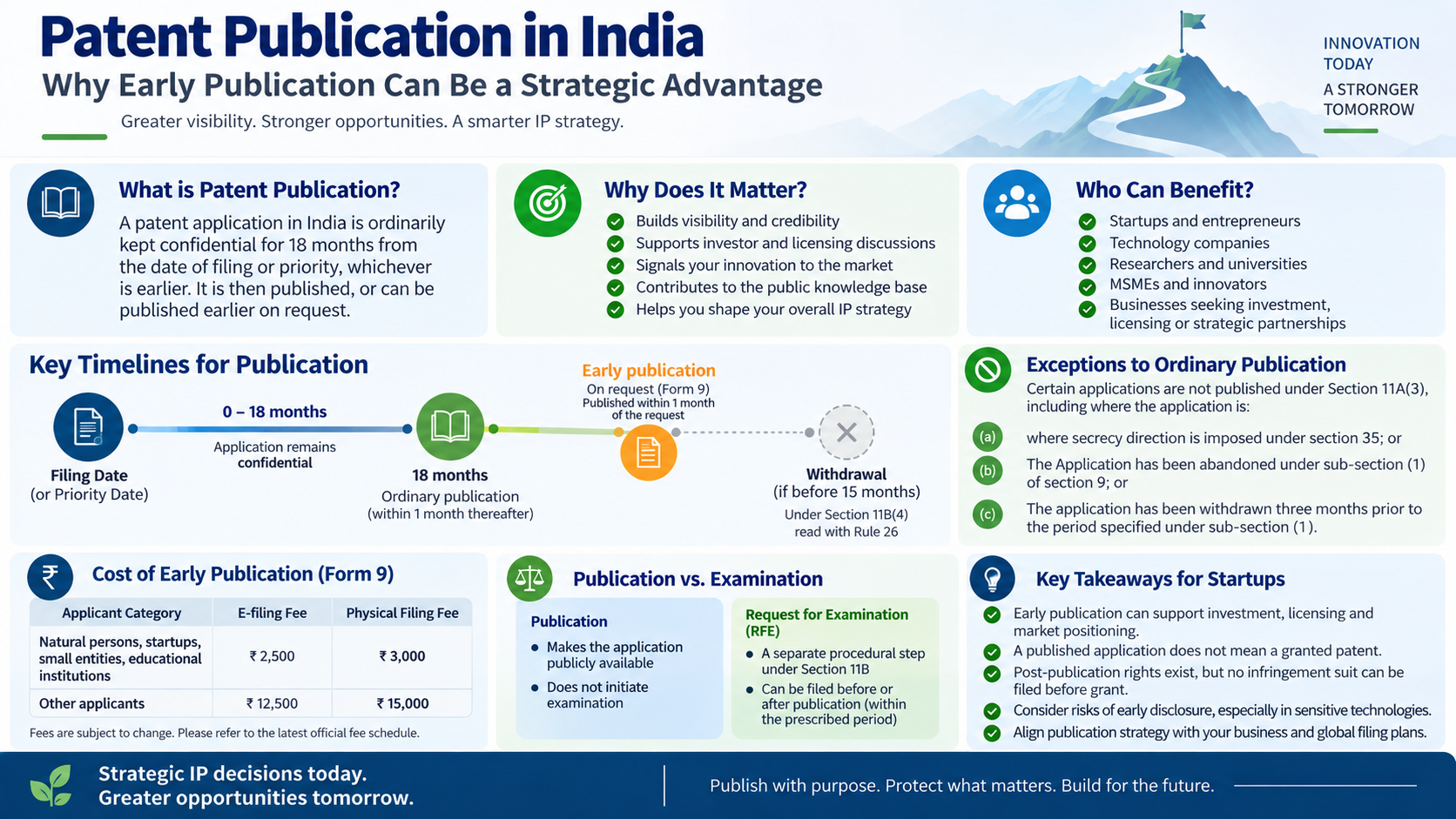
Understanding publication, early publication, confidentiality and strategic considerations for startups and technology businesses
For a startup or technology company, filing a patent application is only the first step. An equally important question is when the application should become public. As a rule, an application is kept secret until it is published; publication takes place after the lapse of a certain period of time, of course, the applicant may request earlier publication. That choice can have implications beyond patent procedure, it can impact investor discussions, licensing, competitive positioning, confidentiality and the broader IP strategy.
What happens after a patent application is filed?
Section 11A of the Patents Act, 1970 provides for publication of patent applications. As a general rule, an application is not open to the public for 18 months from the date of filing or the earliest applicable priority date, whichever is earlier. Rule 24 of the Patents Rules, 2003 provides for ordinary publication within one month after expiry of this period.
This is the general position, but it is subject to statutory exceptions. Under Section 11A(3), ordinary publication does not take place where, for example, a secrecy direction under Section 35 is in force, the application has been abandoned under Section 9(1), or the application has been withdrawn sufficiently early to prevent publication. Where a secrecy direction applies, the timing of publication is governed by the specific statutory provisions concerning cessation of that direction.
An applicant does not necessarily have to wait 18 months. Section 11A(2), read with Rule 24A, permits a request for early publication through Form 9. The application is ordinarily published within one month of the request, subject to the applicable statutory requirements and exceptions.
Key point
The 18-month period is calculated from the date of filing or the applicable priority date, whichever is earlier. Where there are multiple priority claims, the relevant priority position must be carefully reviewed before calculating the expected publication date.
Can an applicant withdraw the application before publication?
Yes, but the timing is important. An applicant wishing to prevent publication must submit the withdrawal request at least three months before expiry of the 18-month period prescribed under Rule 24, relying on Section 11B(4) and Rule 26. Section 11A(3)(c) excludes an application that has been withdrawn within that statutory timeframe from ordinary publication. Where the period runs from the earliest relevant priority date, this will commonly correspond to approximately the 15-month point. The precise deadline should, however, be calculated from the earliest priority dates of the application.
If the application has already been published, subsequent withdrawal does not erase the public disclosure or restore the earlier confidentiality. The practical lesson is that a withdrawal decision intended to prevent publication should be taken and filed within the applicable statutory window.
Why does the law require publication?
Publication fulfils a more extensive function than simply documenting the conclusion of a procedural phase. The patent system aims to reconcile exclusive rights for innovation with the broader distribution of technical knowledge.
Publication promotes transparency by allowing competitors, researchers, investors and technology businesses to know that particular applications have entered the patent system. Published applications can also provide technical information that may be relevant to subsequent research and innovation, even where a particular application does not ultimately result in a granted patent.
These are practical policy functions of publication rather than guarantees that every published application will have the same legal effect in every later patent proceeding. The legal significance of a particular disclosure depends on the relevant statutory provision, the content and timing of the disclosure, and the issue being considered.
Publication does not mean examination
One of the most common misunderstandings is that publication automatically moves an application into examination. It does not. Publication makes the application available to the public; examination requires a Request for Examination (RFE) in the prescribed manner and within 31 months from the date of priority.
Do not treat publication and RFE as the same procedural event
Publication and the Request for Examination are separate procedural steps. An RFE may be filed before publication. Accordingly, the process should not be represented as a rigid sequence in which publication must always occur before the RFE.
A more accurate high-level description is:
Filing → separate publication and RFE stages → examination → grant or refusal
Referral of an application for examination is also subject to the applicable procedural requirements. Publication and filing an RFE should therefore not be understood as automatically guaranteeing immediate examination or referral. Early publication brings the application into the public domain sooner; it does not replace the RFE.
What does early publication cost?
The financial cost of Form 9 is one consideration, but it is often less significant than the commercial value of preserving or releasing confidentiality.
As of the date of publication of this article, under the First Schedule to the Patents Rules, 2003, the Form 9 fee is ₹2,500 for e-filing by a natural person, startup, small entity or educational institution, and ₹12,500 for other applicants. The corresponding physical-filing fees are ₹2,750 and ₹13,750. Eligibility for the lower fee depends on the applicable applicant category and compliance with the requirements for claiming that status. The official fee schedule should be checked on the filing date. The more important question is whether earlier public disclosure is commercially desirable.
Why might a startup want early publication?
Consider a startup that has developed a technology and is preparing for a funding round. Early publication may create an earlier public record that the company has taken formal steps to seek patent protection. This may assist investor due diligence and discussions concerning valuation, investment or strategic partnerships.
Early publication may also be useful when the applicant is entering licensing or technology-collaboration discussions. Public availability of the application can help demonstrate the company's stated IP position, although a pending application should never be represented as equivalent to a granted patent.
There can also be a competitive-signalling benefit. In some sectors, an applicant may deliberately want competitors to know that it has sought protection for a particular technology. Whether that is beneficial depends on the technology, the market, the applicant's commercial objectives and the strength and scope of the claims.
Important due-diligence distinction
A published application shows that an application has been filed and disclosed; it does not establish that the claims are novel, patentable, valid, commercially sufficient or likely to be granted. Ownership and claim scope also require separate consideration.
Does publication give enforceable patent rights?
Not in the same way as a granted patent. Section 11A (7) provides the applicant with certain privileges and rights from the date of publication until grant, but it expressly states that no infringement proceeding may be instituted until the patent has been granted.
This distinction is especially relevant when considering the discussion of possible monetary relief. Publication alone does not create an immediately enforceable damages claim merely because another party later uses the disclosed technology. If a patent is subsequently granted, any infringement issue must be considered against the claims as ultimately granted. Questions of infringement, validity, limitation, conduct of the parties and the statutory requirements for relief would then have to be considered in the appropriate proceedings.
Accordingly, early publication should never be presented as creating an immediately enforceable patent monopoly.
Is early publication appropriate for every applicant?
Certainly not. An applicant may deliberately prefer confidentiality for longer where the technology is still evolving, related inventions are being developed, or some information may be more valuable as confidential know-how.
International filing strategy is another important consideration. Before requesting early publication, an applicant should examine its foreign filing plans, priority position and the information contained in the application. Early public disclosure can affect how the applicant approaches foreign patent protection and disclosure planning; the precise consequences depend on the jurisdiction and filing route.
Publication may also reveal claim scope, implementation details, fallback positions and aspects of the applicant's technology strategy earlier than the business might otherwise choose. Once publication has occurred, withdrawing the application later does not restore the earlier confidentiality.
A strategic decision, not merely a procedural form
For some applicants, early publication can provide meaningful advantages: earlier visibility, support for investor due diligence, greater commercial credibility, licensing or collaboration opportunities, and deliberate competitive signalling.
For others, the additional disclosure may outweigh those benefits. The decision should therefore be made after considering the patent strategy, claim strategy, confidentiality requirements, commercial objectives, international filing plans and competitive environment together.
A practical decision framework
Before filing Form 9, ask: What do we gain by becoming public now? What commercially sensitive information will be revealed? Are our foreign filing plans ready? Are we seeking investment or licensing visibility? Would continued confidentiality provide greater strategic value?
Conclusion
Patent publication is an important part of the architecture of the Indian patent system. It provides public access to technological information while giving applicants an initial period of confidentiality.
Form 9 gives an applicant the option to request publication before the ordinary 18-month period. But early publication is not a substitute for a Request for Examination. Publication does not by itself create an immediately enforceable infringement or damages claim. Section 11A (7) prohibits institution of infringement proceedings until grant. If the patent is later granted, the availability and scope of relief must be assessed in light of the claims as granted, the alleged infringement, validity, limitation, conduct of the parties and the applicable law
For a startup preparing for investment or a technology company pursuing licensing or collaboration opportunities, early publication may sometimes be a useful strategic tool. For another applicant, preserving confidentiality may be more valuable.
The right question is not: “Why wait 18 months?”
The better question is: “Will early publication strengthen our overall IP and business strategy?”
That is where patent procedure ends and IP strategy begins
Frequently Asked Questions About Early Publication of Patent Applications in India
1. What is early publication of a patent application?
Early publication means requesting the Indian Patent Office to publish a patent application before the normal 18-month publication period. The request is made under Section 11A (2) of the Patents Act, 1970, through Form 9 under Rule 24A of the Patents Rules, 2003.
2. Do I have to wait 18 months for my patent application to be published?
No. An application is ordinarily published 18 months after the filing date or the earliest priority date, whichever is earlier. However, an applicant can request early publication through Form 9 instead of waiting for the normal publication date.
3. How quickly is the application published after filing Form 9?
Under the Rules, the Patent Office ordinarily publishes the application within one month from the date of the request for early publication, subject to the applicable statutory requirements and exceptions.
4. How much does early publication cost?
For e-filing, the current prescribed fee for Form 9 is ₹2,500 for natural persons, startups, small entities and educational institutions, and ₹12,500 for other applicants. The applicable fee should be verified against the current official fee schedule, particularly where the applicant has a specific status or the application is filed physically.
5. Does early publication mean that my patent has been granted?
No. Publication only means that the patent application has become publicly available. It does not mean that the Patent Office has accepted the invention or that a patent has been granted.
The application must still undergo the applicable examination process and satisfy the requirements of the Patents Act and Rules.
6. Can I sue someone for infringement immediately after my application is published?
No. Section 11A (7) provides certain rights and privileges to the applicant from publication, but expressly states that infringement proceedings cannot be instituted until the patent has been granted.
Therefore, a published patent application should not be treated as an enforceable granted patent.
7. Does early publication automatically result in earlier examination?
No. Early publication and examination are separate matters.
An applicant must still file the Request for Examination (RFE) within the applicable period under Section 11B. Early publication may facilitate the subsequent examination process once the necessary requirements are fulfilled, but filing Form 9 does not replace the RFE.
8. What are the main advantages of early publication for a startup?
Early publication may be useful when a startup wants to establish an early public record of its technology. It can assist in investor due diligence, licensing discussions, technology collaborations and competitive positioning.
It may also demonstrate that the startup has taken formal steps towards protecting its technology, although a pending application should not be represented as a granted patent.
9. Can early publication be disadvantageous?
Yes. Early publication means that the information disclosed in the application becomes publicly accessible sooner.
If an applicant is still developing the technology, considering related inventions, or deciding whether certain information should remain confidential, early publication may not be appropriate. International filing strategy should also be considered before making the request.
10. Should every innovator request early publication?
Not necessarily. Early publication is a strategic choice, not an automatic recommendation.
An innovator should consider the nature of the invention, commercial objectives, investment or licensing plans, confidentiality requirements, international filing strategy and competitive environment before deciding.
The key question is not simply, “Can I publish my application early?” but rather, “Will early publication strengthen my overall IP and business strategy?”
Source:
- https://ipindia.gov.in/acts/patent-act-1970/section-11a
- https://ipindia.gov.in/acts/patent-rules-2003
Disclaimer: This content is provided for general informational and educational purposes only and does not constitute legal advice. Patent rights and procedures may vary depending on the facts and circumstances of each case; professional advice should be obtained before taking any action.